
Token Analyzer
Economic simulation and analysis tool for tokens.
Token & Context Analyzer
The Token Analyzer is a business and architecture tool designed to visualize the exact LLM API costs and payload savings achieved by using Elemm instead of traditional MCP architectures.
When pitching an architectural migration, the most compelling argument is often cost. The Token Analyzer translates Elemm's abstract protocol benefits (like tiered discovery and sequence piping) into concrete, verifiable metrics—token volume and dollar savings.
Key Features
- Live Connection Mapping: Connect to any API and automatically calculate the cost of force-loading its entire schema versus using Elemm.
- Context Economy Ledger: View estimated savings per conversation turn, factoring in sequence piping and prompt caching.
- Payload Comparisons: View side-by-side length comparisons of traditional MCP JSON vs. Elemm Compact schemas for individual endpoints.
- Gateway Overhead Simulation: A detailed, mathematical breakdown proving how Elemm achieves up to 90% reductions in context bloat.
Why Use the Analyzer?
While developers love Elemm for its technical elegance, the Token Analyzer exists to answer the management question: "Why do we need this gateway instead of just loading tools directly into the LLM?"
By simulating real-world agent workloads, it mathematically proves the massive Return on Investment (ROI) of Elemm's lazy-loading and sequence-piping architecture.
Key Capabilities
1. Live Context Profiling
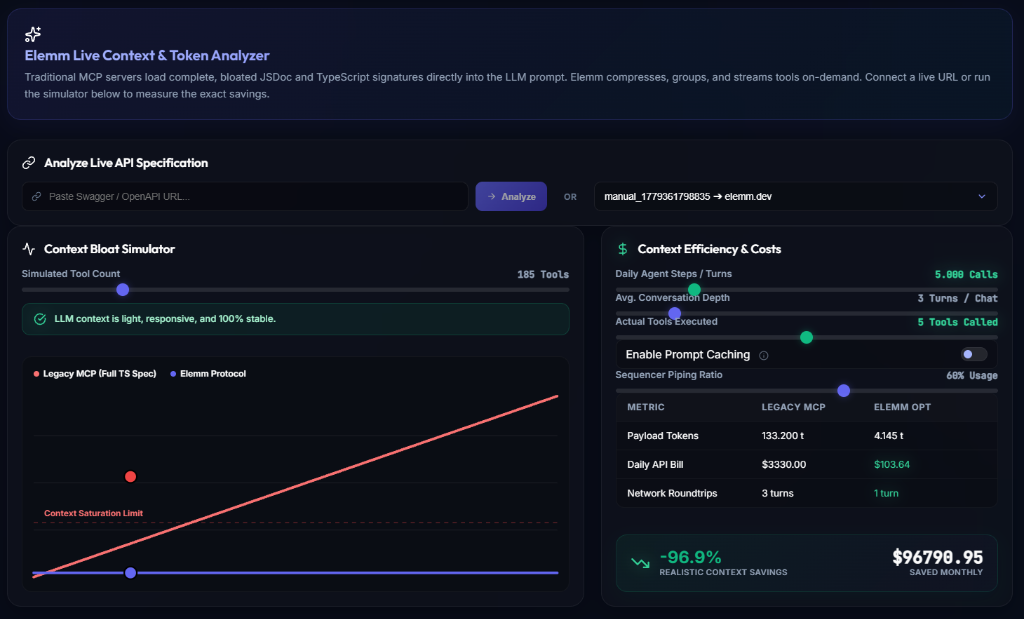
- Analyze Live API: Paste any OpenAPI/Swagger URL (or connect to a local MCP environment) to instantly calculate its raw token footprint.
- Context Bloat Simulator: See exactly at what point a traditional MCP setup will cross the "Context Saturation Limit" (causing the LLM to hallucinate or crash). Because Elemm uses a lazy-loaded topology, its context line remains flat and 100% stable regardless of how many tools the API contains.
2. Economic & Architectural Simulation
Adjust sliders to match your AI agent's real-world traffic:
- Conversation Depth & Agent Steps: Simulates the multiplying effect of multi-turn conversations on token consumption.
- Sequencer Piping Ratio: Visualizes the network benefits of Elemm. By piping outputs directly into inputs on the gateway level (
execute_sequence), Elemm can slash network roundtrips from 3-4 turns down to just 1. - Prompt Caching: Toggle caching to see how Elemm's stable, deterministic discovery protocol maximizes cache-hits compared to dynamically injecting massive tool lists.
3. The Bottom Line
The Context Efficiency & Costs panel translates bytes into dollars, providing concrete metrics (e.g., "-96.9% Context Savings" and "Monthly $ Saved") that can be used to forecast AI API billing and justify architectural decisions to stakeholders.
Deep Dive: Specification Analysis
By clicking on the "Analyze" button, you enter the detailed Spec Profile for the target API. This is where real-time, live data from your connection is used to prove Elemm's efficiency.
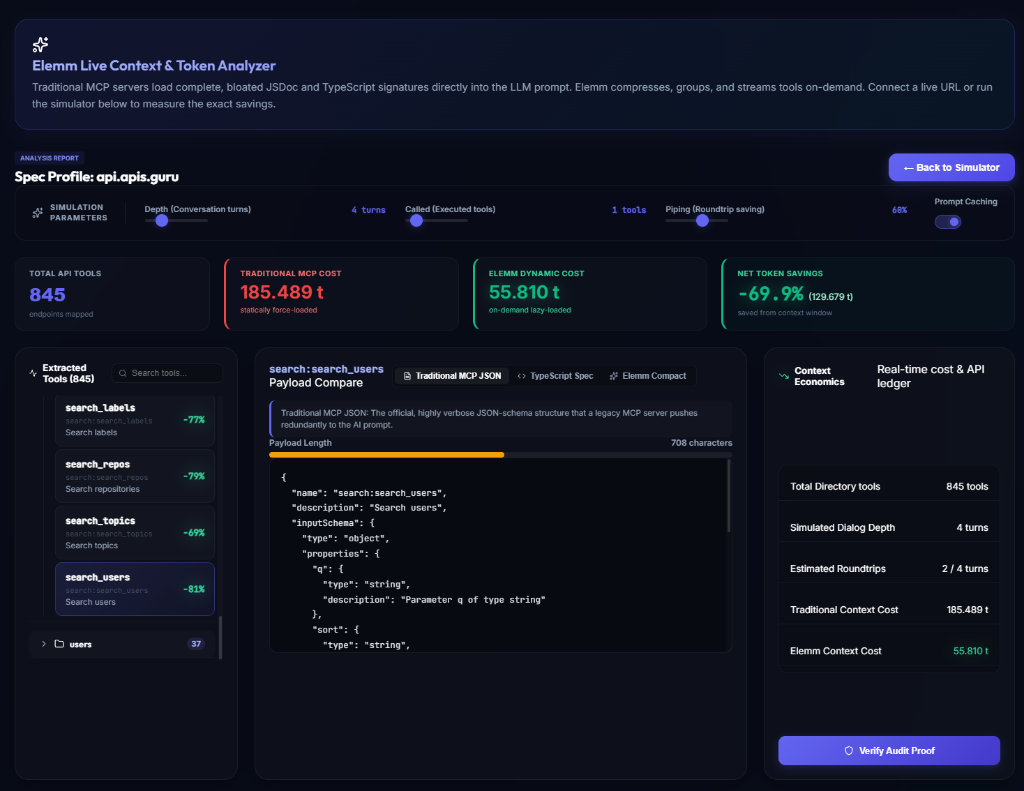
The analyzer maps all endpoints (e.g., 845 tools in a large API) and simulates a live agent conversation to calculate exactly how many tokens are saved compared to static force-loading.
Payload Comparison
To understand how Elemm achieves these savings, the analyzer allows you to inspect and compare the raw payloads of individual tools across three formats:
- Elemm Compact
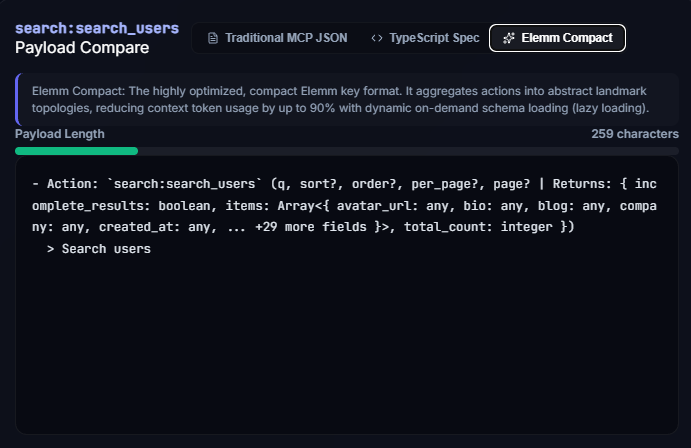
The highly optimized Elemm key format. It aggregates actions into abstract landmark topologies. Because schema details are lazy-loaded on-demand, a tool signature is drastically reduced (e.g., 259 characters).
- TypeScript Spec
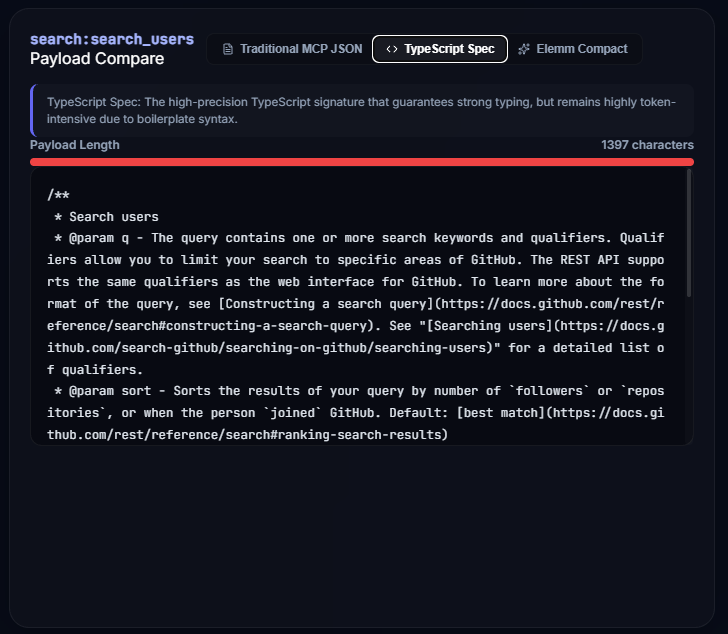
A high-precision TypeScript signature that guarantees strong typing for agents, but remains highly token-intensive (e.g., 1397 characters) due to boilerplate syntax and JSDoc comments.
- Traditional MCP JSON
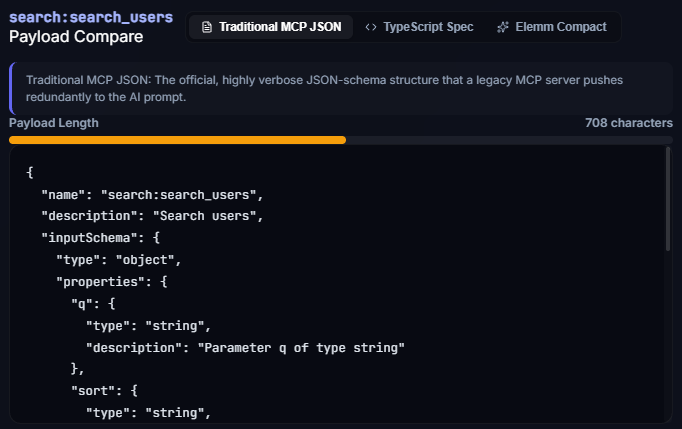
The official, highly verbose JSON-schema structure that legacy MCP servers push redundantly to the AI prompt (e.g., 708 characters).
Gateway Overhead & Context Simulation
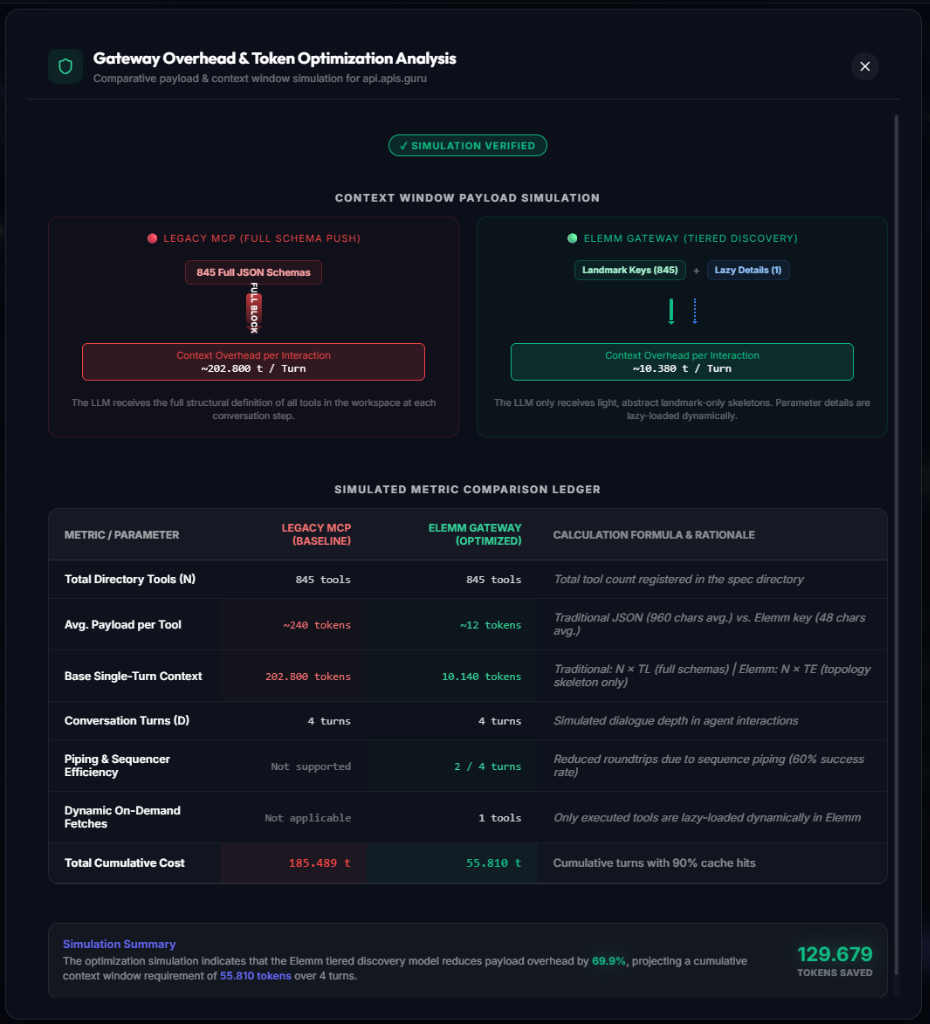
Finally, the Gateway Overhead Analysis provides a mathematical breakdown (the Ledger) of the simulation:
- Legacy MCP (Full Schema Push): Pushes all 845 full JSON schemas into the context window, resulting in massive overhead per interaction (e.g., ~202,800 tokens per turn).
- Elemm Gateway (Tiered Discovery): Pushes only lightweight Landmark Keys, fetching full details dynamically for only the 1 or 2 tools that the agent actually executes (e.g., ~10,380 tokens per turn).
The resulting metric (e.g., 69.9% Context Saved) demonstrates Elemm's real-world impact on both performance and API costs.